

Thousands of miles of high-pressure steel make up the stage, in the great industrial theater, where energy is the star. These pipes are mostly buried deep in the earth or they are submerged in hostile aqua environments and that is why they are the silent work horses of the modern civilization. Nonetheless, they cannot be seen, and hence cannot be thought of, until there is an issue, which is when they are needed. These lines are susceptible to outside forces which in time may weaken the physical integrity of these lines or even the weight of the earth itself which shelters them.
Safer Means
To ensure the flow is safe and efficient, engineers must have a means of seeing the earth and to the very inside of the metal. What they require is a diagnostic tool that would be in a position to trace the internal circumference of the pipes in every millimeter without necessarily excavating a hole. This is where the industry is resorting to a mechanical scout who is specialized. This gadget is not just a cleaner but an extremely accurate auditor of structural health. This specialized process is commonly referred to as caliper pigging and it gives the information to assure that the geometry of the pipeline is as it was initially designed. These tools serve the purpose of being the eyes and ears of the maintenance crew as they move along the line and capture physical deviations that may point to a dent, a buckle, a major alteration in the ovality of the pipe.
The Mechanics of Interior Inspection
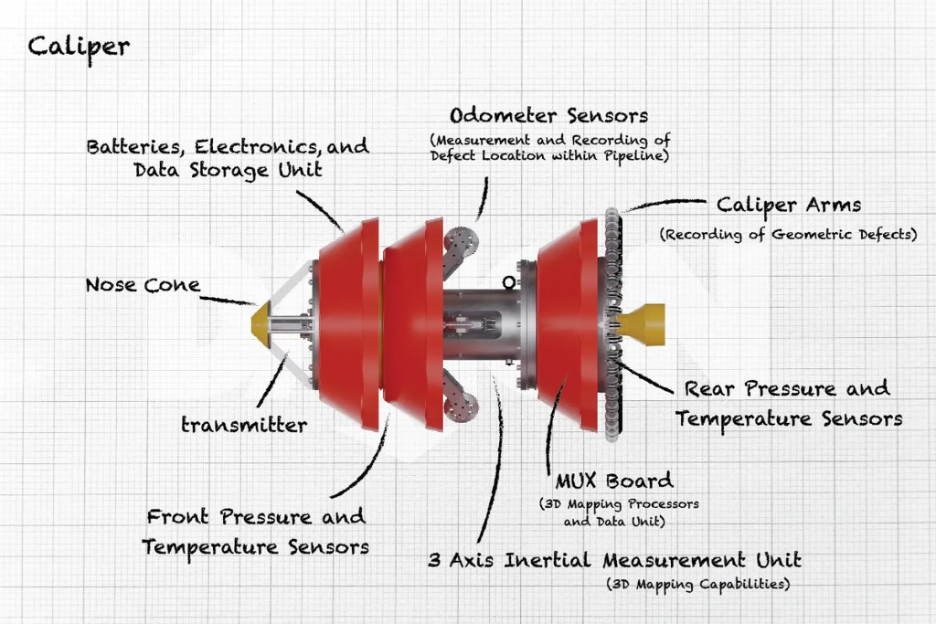
This is initiated by taking the device and dropping it into a stream that has high pressure. The geometry sensing unit does not have all the cleaning tools as seen in the standard cleaning but has a ring of mechanical fingers or electrical sensors that are in constant touch with the inside wall. Each time the pipe is narrowed or a dent met, these fingers deflect sending a signal to an onboard data logger. It is a work of art of rough engineering. The device should be delicate enough to feel the dent that is less than a coin but strong enough to endure being pushed through the dark high-pressure tunnels miles long by the pressure of a compressed air or moving liquid. The data taken at a caliper pigging run is the snapshot of the asset in the year zero. It shows the precise setting of the pipe since it was laid initially at the trench. This information is the ultimate currency of security in the international energy market. Instead, it enables operators to put various parts of the pipe into priority on their expenditure in maintenance, and they are only required to repair the sections that are exhibiting real structural distress.
Translating Data into Actionable Intelligence
The security of such huge networks is a task that involves technology worldwide and experience locally. In areas where the environment is so unfriendly, the inspection standards are, to be expected, stiffer. These advanced diagnostic techniques have been tested over the decades in the industrial landscape of Saudi Arabia. The size of the energy infrastructure in Saudi Arabia implies that any little inefficiency may cause tremendous logistical challenges. Most of the best practices employed to interpret the geometry data have been spearheaded by engineers who have been working in Saudi Arabia. They know that a dent in a desert place acts not like a dent in a temperate climate, because of the excessive thermal expansion of the steel. This knowledge base that is entrenched in Saudi Arabia has set a standard to the rest of the world.
Converting Data into Usable Intelligence
After the scanning device is pulled out of the receiving trap, the technical problem changes into the analytical. The data measured are huge numbers of coordinates and measurement of deflection. Professionals have to separate this noise to distinguish between a non-dangerous weld bead and a critical structural defect. It is a translation process the language of mechanical deflections and transforming it into the clear and visual map of the health of the pipeline. This is particularly a critical stage of diagnosis during the commissioning of a new line. It serves as the ultimate quality control measure to the construction contractor.
Your Structural Certainty Partner
At CS Arabia, we are of the opinion that information is the greatest weapon in any maintenance arsenal. We do not simply consider ourselves a service provider, we are the custodians of the long-term health of your infrastructure. We know that your pipelines are not ordinary steel tubes, but the lifeline that drives economies and supports communities. That is the reason why we introduce some level of concentration and technical strictness to any inspection project we are pursuing so that not a single detail is missed. Our model is a mix of a combination of the most recent sensor technologies and an appreciation of the distinct environmental issues that our clients may be struggling with.